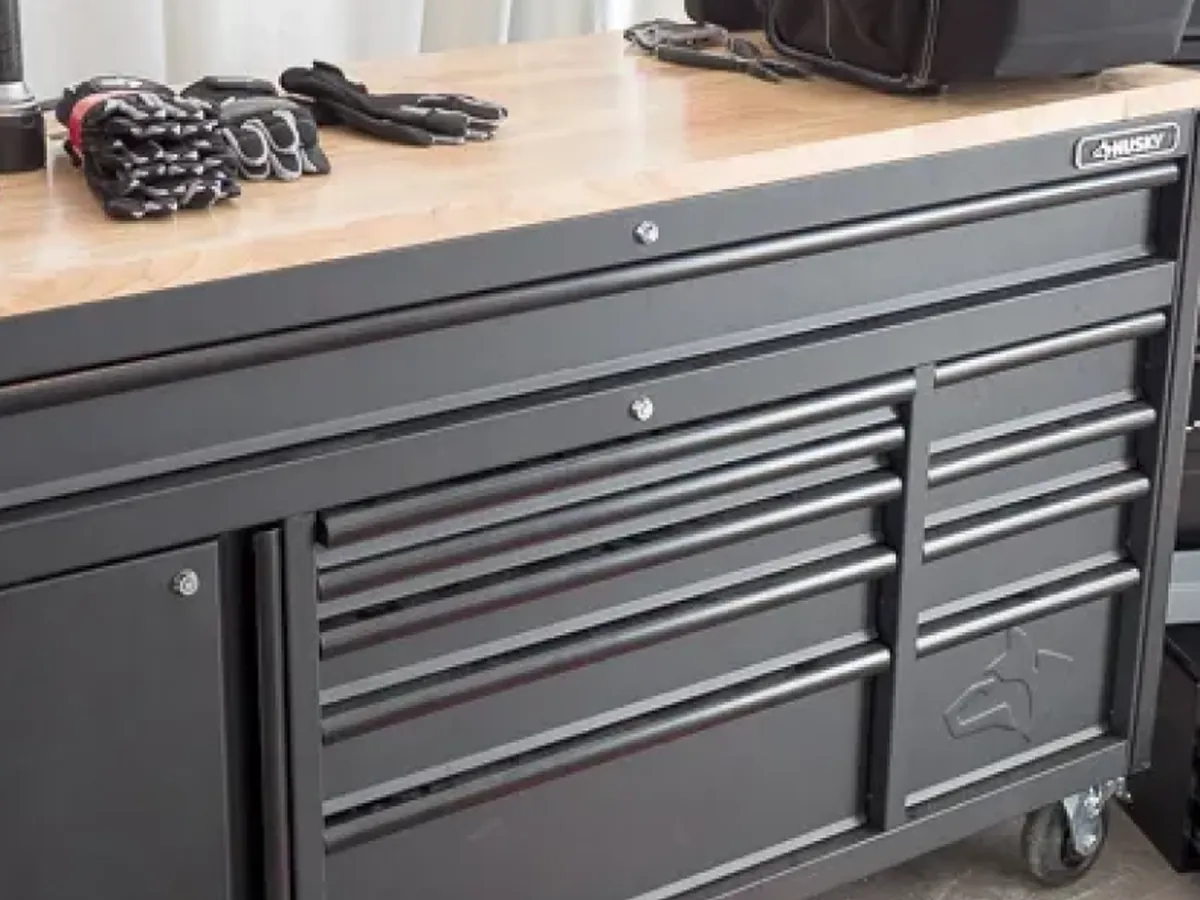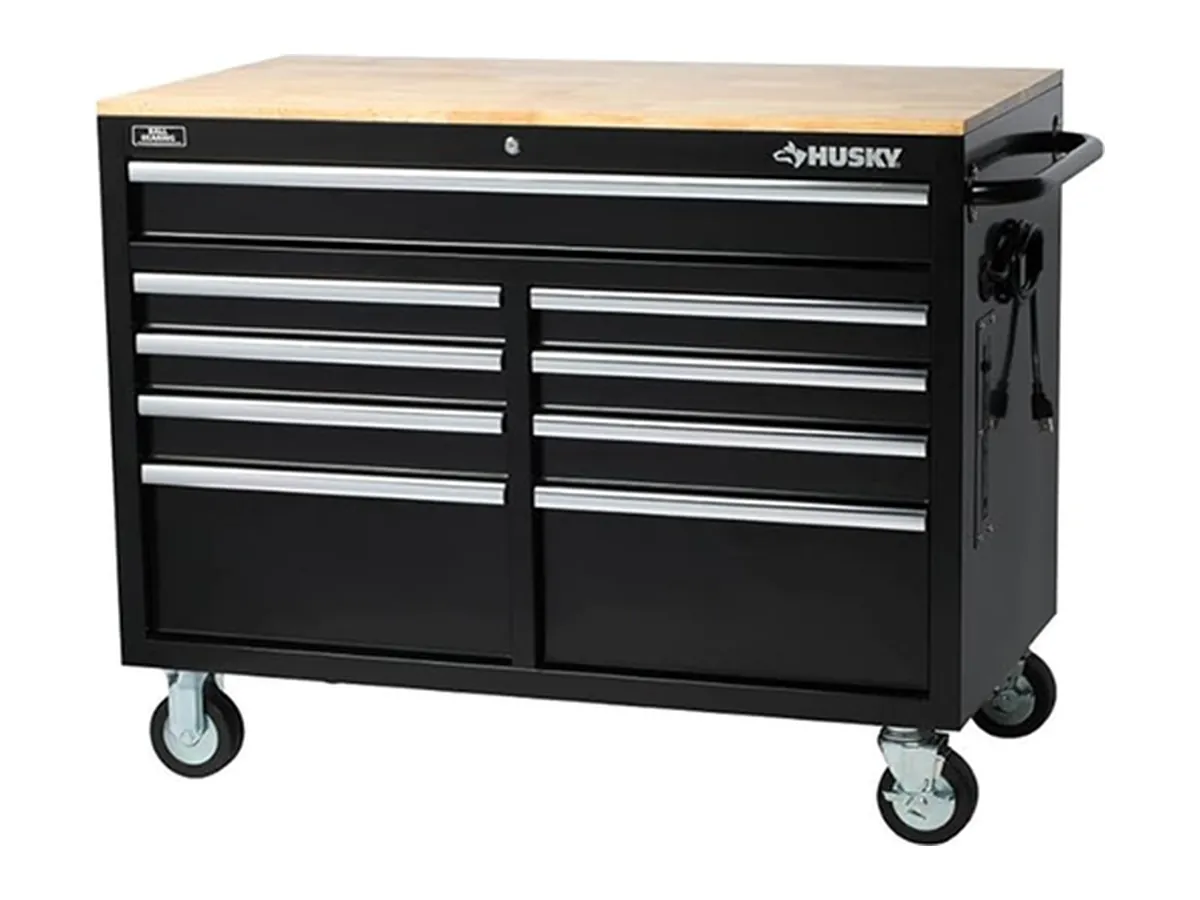
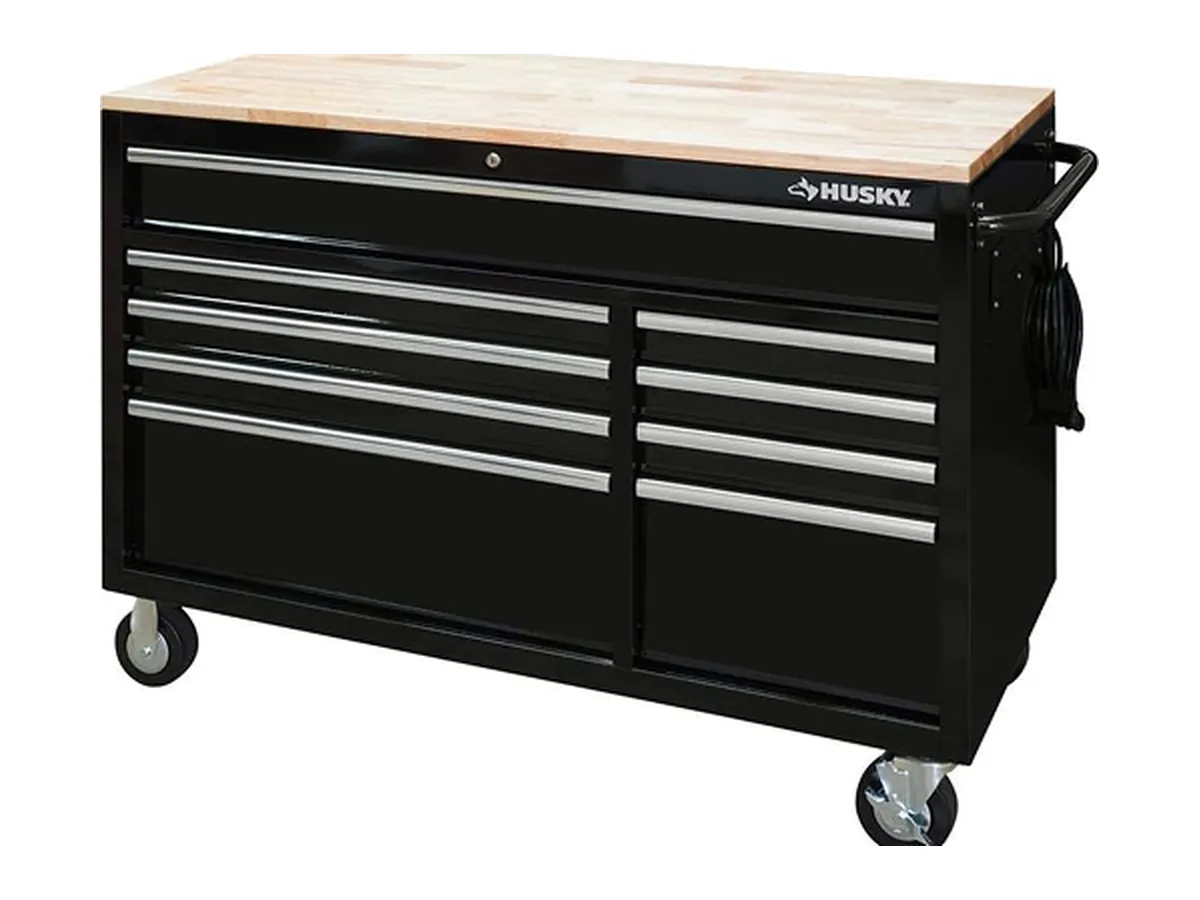
Not every garage has room for a 6-foot workbench. Husky's extra-deep 46-inch mobile workbench fits nine drawers and a solid wood work surface into a footprint under 4 feet wide, and its drawers are much deeper than a typical tool chest's. It's one of the more popular benches in Husky's line. Here's what makes it work and what to keep in mind.
What Makes It Different
Depth is the point of this bench. The cabinet is about 24.5 inches deep and the drawers run roughly 21.7 inches front to back, so long tools, cordless drills with batteries and boxed accessories fit without hunting for space. Husky says the extra depth gives about a third more storage than a traditional 18-inch-deep chest.
The top drawer is wide and shallow for hand tools, and the lower drawers get taller as you go down. Standard drawer slides are rated at 100 lb, and the bottom drawers use a second set of slides for heavier loads up to 200 lb.
The frame is all-welded steel, the top is solid wood, and a built-in power strip with USB ports keeps chargers at hand. It rolls on casters, and at about 220 lb it is far easier to move than Husky's 72-inch benches.
Pros & Cons
Pros
- Deep drawers swallow bulky power tools
- Compact width fits smaller garages
- Bottom drawers rated for heavier loads
- Built-in power strip with USB
- Rated 4.4 out of 5 by buyers at the time of writing
Cons
- Fixed-height top, no adjustment
- Work surface is smaller than a full-size bench
- Still heavy enough to need two people when moving it
- Deep drawers take more floor space when open
Who It's For
- One-car garages and basements where a 72-inch bench won't fit.
- Cordless tool owners who want drills, drivers and batteries in drawers instead of on shelves.
- A first serious tool cabinet that doubles as a work surface.
- Not ideal for anyone who needs an adjustable work height or a large surface for big projects.
46 in. 9-Drawer vs 72 in. 18-Drawer
| 46 in. 9-Drawer | 72 in. 18-Drawer | |
|---|---|---|
| Width | 46 in. | 72 in. |
| Drawers | 9 | 18 |
| Work surface height | Fixed, about 37 in. | Adjustable with a crank |
| Top | Solid wood | 1 in. solid wood |
| Drawer depth | Extra deep, about 21.7 in. | Standard |
| Built-in power | Power strip with USB | Power strip with USB |
| Weight | About 220 lb | Over 500 lb |
With drawers this deep, leave about 2 feet of clear floor in front of the bench so the lower drawers open fully without hitting a car or shelf.
Organizing Extra-Deep Drawers
Deep drawers hold a lot, but they also make it easy to lose small items at the back. Shallow trays or drawer dividers keep sockets, bits and fasteners in rows, and putting the tools you use most at the front saves pulling every drawer all the way out.
The tall bottom drawers, with their extra set of slides, are the natural home for cordless tools, battery packs and chargers. Keeping batteries next to the built-in power strip means you can charge them without leaving cords across the floor, and a simple label on each drawer front helps everyone in the house put things back.
Setting It Up
- Move it empty. At about 220 lb it rolls easily on a smooth floor, but it's still a two-person lift over a step.
- Check the drawer clearance. Make sure the deep drawers can open fully before you settle on a spot.
- Lock the casters. Lock the wheels once it's in place so it stays put while you work.
- Heavy items low. Use the reinforced bottom drawers for the heaviest tools to keep the bench stable.
Using and Caring for the Wood Top
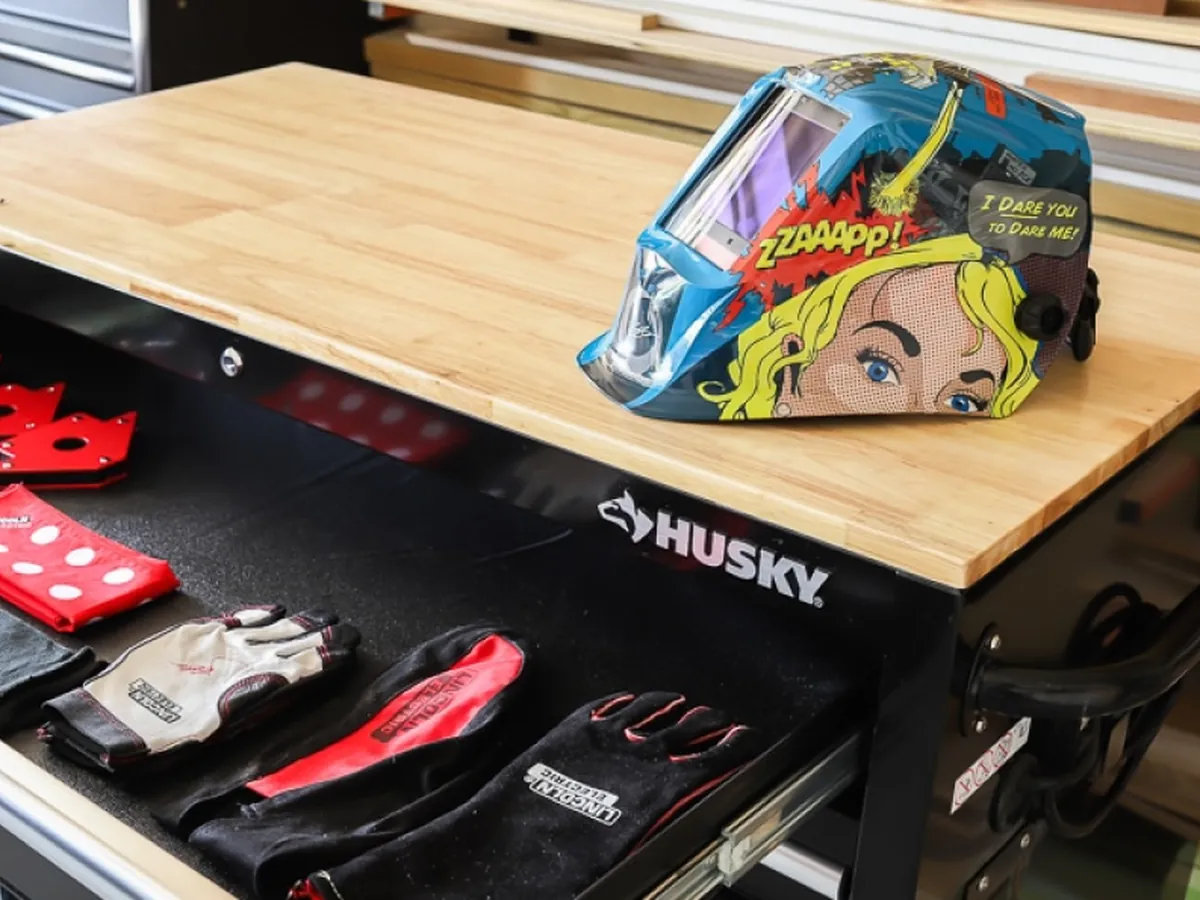
The solid wood surface is comfortable to work on and kinder to tools than bare steel, but it's still wood. Wipe up oil, paint and solvents promptly, and give it a coat of wood oil or butcher-block conditioner when it starts to look dry.
For dirty jobs such as engine parts or finishing work, lay down a rubber mat or a piece of hardboard first. It protects the top and makes clean-up much faster, and you can replace a worn board far more cheaply than the bench.
When You Might Want Something Bigger
This bench is ideal as a compact tool station, but it isn't a full-size work surface. If you regularly build furniture, work on long boards or need space for two people side by side, a wider bench will be less frustrating.
The same applies if your tool collection is still growing quickly. Nine deep drawers hold a lot, yet some owners eventually add a second unit or step up to a larger bench. Measuring the tools you already own, and adding some room to grow, is the simplest way to decide.
Final Verdict
For most home garages this is the more practical Husky bench: lots of deep storage, a usable wood top and a footprint that fits almost anywhere. If you want more drawers and a work surface you can raise and lower, look at the 72-inch 18-drawer model instead.
FAQ
How deep are the drawers?
Listings give an interior drawer depth of about 21.7 inches, noticeably deeper than standard 18-inch-deep tool chests.
How much weight can the drawers hold?
Standard drawer slides are rated at 100 lb each, and the bottom drawers have an extra set of slides for loads up to 200 lb.
Is the height adjustable?
No. The top is fixed at roughly 37 inches. For an adjustable top, Husky's 72-inch 18-drawer bench uses a crank.
Can I mount a vise on the wood top?
Many owners add a small bench vise. Before drilling, check that the bolts will clear the top drawer and the steel frame underneath.
Will it fit under a standard garage shelf?
At roughly 37 inches tall it fits under most wall shelving and cabinets, but measure your space, including the side handle and power strip, before buying.